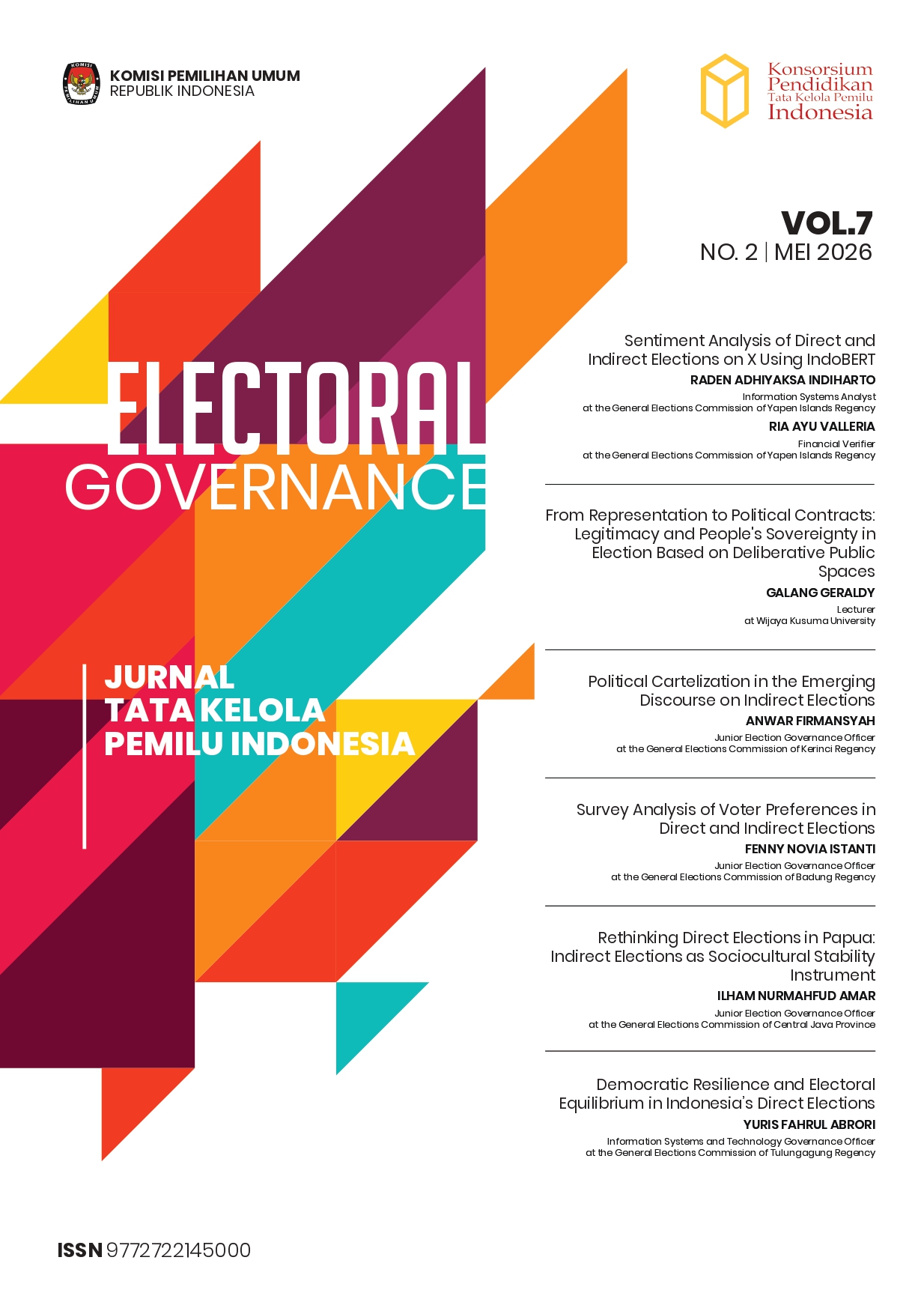
FROM REPRESENTATION TO POLITICAL CONTRACTS: LEGITIMACY AND PEOPLE'S SOVEREIGNTY IN ELECTION BASED ON DELIBERATIVE PUBLIC SPACES
DOI:
https://doi.org/10.46874/hyk64k49Keywords:
political representation, deliberative public space, political contract, democratic legitimacy, popular sovereigntyAbstract
This article examines the tension between procedural legitimacy and substantive popular sovereignty in Indonesia’s electoral democracy. Although post-authoritarian elections have become institutionally consolidated, they often prioritize formal vote aggregation over meaningful communicative engagement. This gap fosters clientelism, transactional politics, and weakened post-election accountability, reducing citizens to passive voters rather than active participants. Using qualitative library research, this study integrates Hanna Pitkin’s theory of political representation and Jürgen Habermas’s concept of the deliberative public sphere. It develops a conceptual framework reinterpreting elections as arenas for public reasoning and collective will formation. The findings suggest that procedural dominance weakens democratic legitimacy by separating electoral competition from rational deliberation. To address this, the article proposes a deliberative political contract-based model centered on three principles: informed consent, deliberative participation, and continuous accountability. Through this framework, citizens are positioned as active political subjects capable of shaping, monitoring, and evaluating binding political commitments. The study concludes that genuine democratic legitimacy requires evolving elections into deliberative spaces that encourage programmatic competition and enforceable accountability between representatives and citizens.
References
Anggraini, T. (2019). Electoral integrity and the challenge of money politics in Indonesia. Journal of Indonesian Electoral Studies, 1(1), 1–15.
Aspinall, E., & Berenschot, W. (2019). Democracy for sale: Elections, clientelism, and the state in Indonesia. Cornell University Press.
Aspinall, E., & Sukmajati, M. (Eds.). (2016). Electoral dynamics in Indonesia: Money politics, patronage and clientelism at the grassroots. NUS Press.
Beetham, D. (1999). Democracy and human rights. Polity.
Chambers, S. (2003). Deliberative democratic theory. Annual Review of Political Science, 6(1), 307–326. https://doi.org/10.1146/annurev.polisci.6.121901.085538
Cohen, J. (1989). Deliberation and democratic legitimacy. In A. Hamlin & P. Pettit (Eds.), The good polity: Normative analysis of the state (pp. 17–34). Basil Blackwell.
Dahl, R. A. (1989). Democracy and its critics. Yale University Press.
Dryzek, J. S. (2000). Deliberative democracy and beyond: Liberals, critics, contestations. Oxford University Press.
Farrell, D. M., Suiter, J., & Harris, C. (2019). Systematizing constitutional deliberation. Irish Political Studies, 34(1), 113–123.
Fishkin, J. S. (2009). When the people speak. Oxford University Press.
Habermas, J. (1989). The structural transformation of the public sphere: An inquiry into a category of bourgeois society (T. Burger, Trans.). MIT Press. (Original work published 1962)
Habermas, J. (1996). Between facts and norms: Contributions to a discourse theory of law and democracy (W. Rehg, Trans.). MIT Press.
Hobbes, T. (1996). Leviathan. Cambridge University Press. (Original work published 1651)
Kompas. (2023, November 15). Debat capres dinilai masih minim adu program. Kompas. https://www.kompas.com
Locke, J. (1988). Two treatises of government. Cambridge University Press. (Original work published 1689)
Lupia, A., & McCubbins, M. D. (1998). The democratic dilemma. Cambridge University Press.
Mietzner, M. (2013). Money, power, and ideology: Political parties in post-authoritarian Indonesia. NUS Press.
Mietzner, M. (2020). Authoritarian innovations in Indonesia: Electoral narrowing, identity politics and executive illiberalism. Democratization, 27(6), 1021–1036. https://doi.org/10.1080/13510347.2019.1704266
Mujani, S., Liddle, R. W., & Ambardi, K. (2018). Voting behavior in Indonesia since democratization. Cambridge University Press.
Muhtadi, B. (2019). Vote buying in Indonesia: The mechanics of electoral bribery. Palgrave Macmillan.
Noor, F. (2012). Institutionalizing the political party in Indonesia. Journal of Current Southeast Asian Affairs, 31(3), 57–80.
Norris, P. (2014). Why electoral integrity matters. Cambridge University Press.
Pitkin, H. F. (1967). The concept of representation. University of California Press.
Rousseau, J.-J. (2012). The social contract. Dover. (Original work published 1762)
Snyder, H. (2019). Literature review as a research methodology: An overview and guidelines. Journal of Business Research, 104, 333–339. https://doi.org/10.1016/j.jbusres.2019.07.039
Sukmajati, M., & Aspinall, E. (Eds.). (2015). Electoral dynamics in Indonesia: Money politics, patronage and clientelism at the grassroots. NUS Press.
Sunstein, C. R. (2018). #Republic. Princeton University Press.
Tempo. (2024, January 10). Akses informasi pemilih dan problem kualitas kampanye. Tempo. https://www.tempo.co
Tomsa, D. (2010). The Indonesian party system after the 2009 elections: Towards stability? Journal of Current Southeast Asian Affairs, 29(1), 141–159.
Downloads
Published
Issue
Section
License
Copyright (c) 2026 Electoral Governance Jurnal Tata Kelola Pemilu Indonesia

This work is licensed under a Creative Commons Attribution-NonCommercial-ShareAlike 4.0 International License.
Terms and Conditions of Publication
1. Author's Rights and Authorities
As an author, you (or your employer or institution) may do the following:
- make copies (print or electronic) of the article for your own personal use (not for commercial purpose), including for your own classroom teaching use;
- make copies and distribute such copies (including through email) of the article to research colleagues, but not allowed to distribute commercially and systematically, e.g. via an email list or list server;
- present the article at a meeting or conference and to distribute copies of the article to the delegates attending such meeting;
- retain all proprietary rights in any process, procedure, or article of manufacture described in the work;
- include the article in full or in part in a thesis or dissertation;
- use the article or any part thereof in a printed compilation of your works, such as collected writings or lecture notes, and other derivative works, with full acknowledgement to JEP as the original journal publishing the article;
- may reproduce material extracted from the article or derivative works for the author's personal use, but must consider the copyrights procedure.
All copies, print or electronic, or other use of the paper or article must include the appropriate bibliographic citation for the article’s publication in the journal.
2. Requests from Third Parties
Although authors are permitted to re-use all or portions of the article in other works, this does not include granting third-party requests for reprinting, republishing, or other types of re-use. Requests for all uses not included above, including the authorization of third parties to reproduce or otherwise use all or part of the article (including figures and tables), should be referred to KPU by going to our website at https://journal.kpu.go.id/.
3. KPU Copyright Ownership
KPU owns the copyrights to reproduce, distribute, disseminate, translate, and other uses in accordance with the existing Laws and Regulations.
Every accepted manuscript should be accompanied by "Copyright Transfer Agreement" prior to the article publication.

This work is licensed under a Creative Commons Attribution-NonCommercial 4.0 International License.
Electoral Governance (Jurnal Tata kelola Pemilu Indonesia) by KPU is licensed under a Creative Commons Attribution-NonCommercial-ShareAlike 4.0 International License. Permissions beyond the scope of this license may be available at https://journal.kpu.go.id/index.php/TKP
If you are a nonprofit or charitable organization, your use of an NC-licensed work could still run afoul of the NC restriction, and if you are a for-profit entity, your use of an NC-licensed work does not necessarily mean you have violated the term.