Journal Introduction


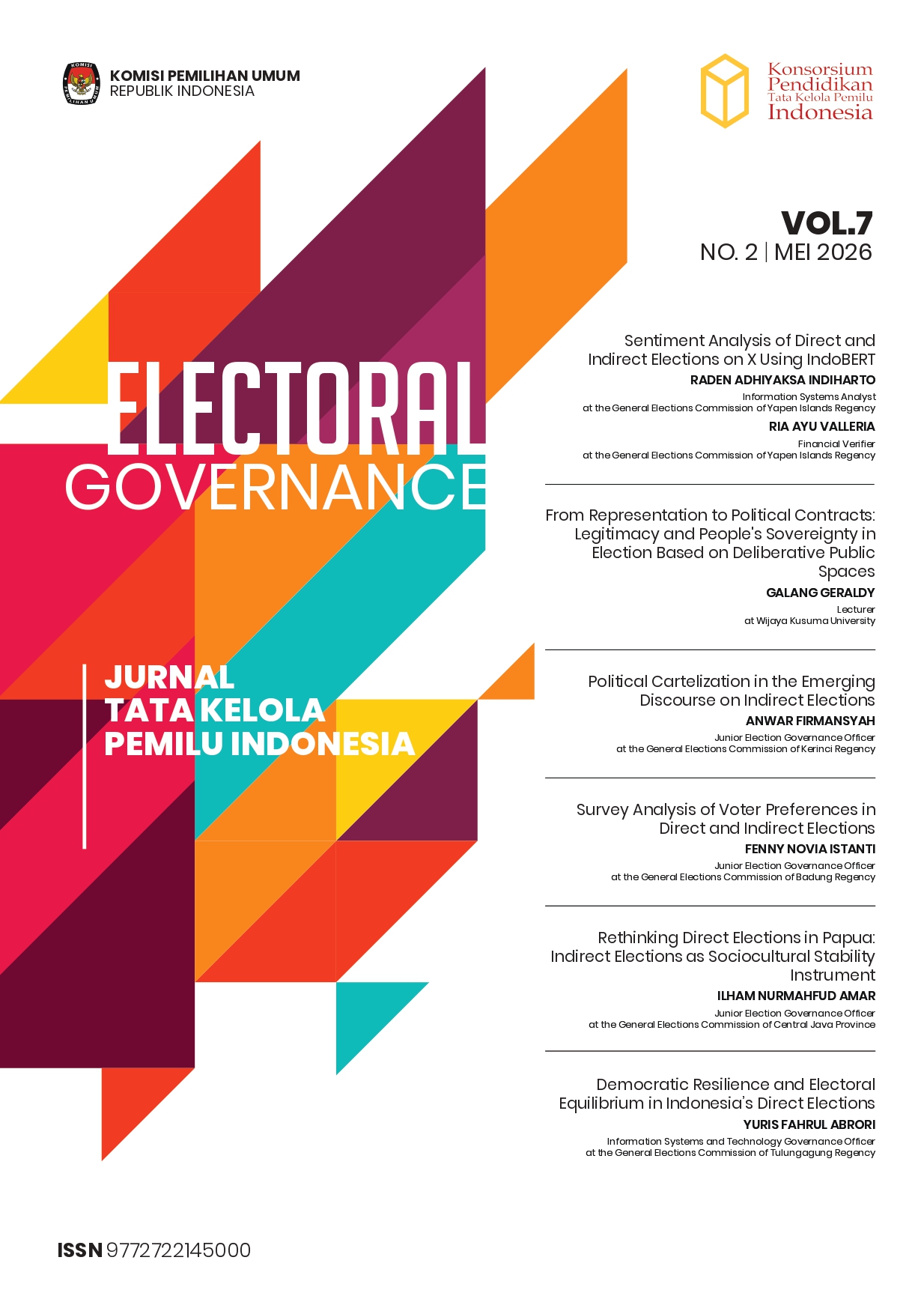
The General Elections Commission of the Republic of Indonesia, in collaboration with the Electoral Governance Consortium representing 12 (twelve) leading universities in Indonesia, presents Electoral Governance: Jurnal Tata Kelola Pemilu Indonesia Volume 7, Number 2, May 2026. This edition centers on the theme “Direct Elections vs. Indirect Elections”.
This issue brings together a range of perspectives on the dynamics of direct and indirect elections in Indonesian democracy, including analyses of public sentiment on social media, voter preferences, and theoretical discussions on democratic legitimacy and popular sovereignty. Several articles argue that direct elections remain more effective in sustaining political participation, transparency, and accountability, while also functioning as instruments of public control over political elites, even though clientelism, money politics, and political cartelization continue to pose serious challenges. Other studies, however, propose indirect elections as an alternative under certain conditions, particularly for reducing conflict and maintaining sociocultural stability in regions with heightened sociopolitical vulnerability, such as Papua. The discussions presented in this edition also demonstrate how digital public spaces, deliberative political contracts, and technology- and survey-based analytical approaches may be used to understand public perceptions of electoral systems. The issue further reflects efforts to examine electoral democracy more realistically through discussions of the latent functions of clientelism and political costs in maintaining sociopolitical stability during the post-Reformasi period following the 1998 reform movement. Taken together, the articles in this edition enrich the discourse surrounding the future of electoral system design in Indonesia by framing democracy not merely as an electoral procedure, but also as a space for deliberation, representation, and the ongoing pursuit of social stability.
Journal Introduction
Tools