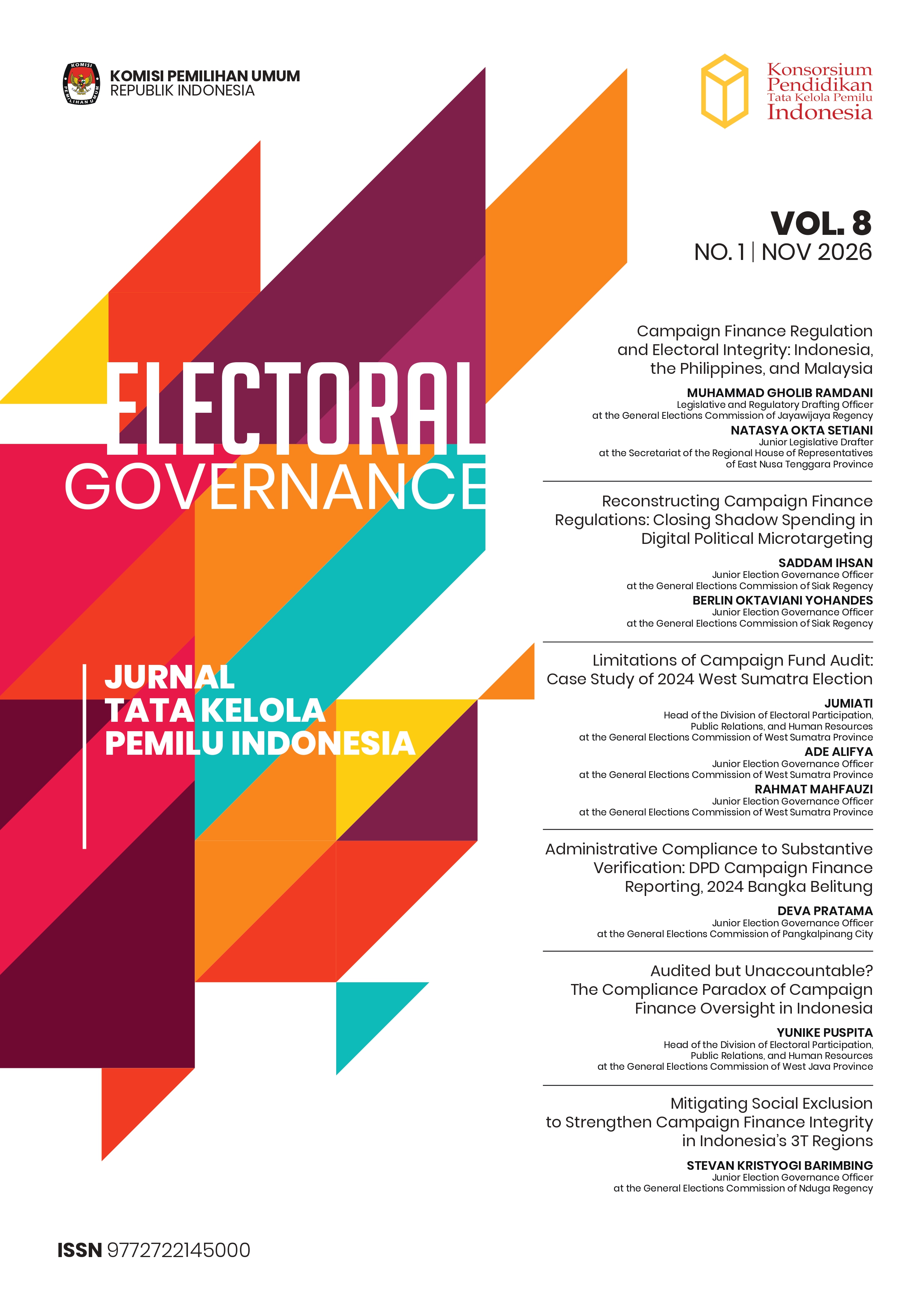
RECONSTRUCTING CAMPAIGN FINANCE REGULATIONS: CLOSING SHADOW SPENDING IN DIGITAL POLITICAL MICROTARGETING
DOI:
https://doi.org/10.46874/8h8bbr78Keywords:
Campaign Finance, Shadow Spending, Political Micro-targetingAbstract
Political microtargeting has emerged as campaigning shifts from conventional methods to digital platforms, creating shadow spending and dark ads that fall beyond the reach of existing campaign finance regulations. This study aims to formulate a regulatory reconstruction by updating campaign expenditure audit standards to encompass digital activities. The study employs doctrinal research based on library research, using legislation as primary sources and multidisciplinary scholarship as secondary sources, analyzed through descriptive, evaluative, and prescriptive approaches. The findings reveal legal anachronism across the dimensions of legal structure, legal substance, and legal culture. Consequently, campaign finance reporting has been reduced to bureaucratic formalities rather than serving as substantive evidence of transparency and accountability. A progressive regulatory framework should recognize digital activities as campaign finance objects by classifying digital campaign transactions as public space expenditures, expanding the scope of digital forensic audits, applying the piercing the corporate veil doctrine, integrating Sikadeka with platform-based political ad libraries through real-time application programming interfaces (APIs), and requiring digital platforms to comply not only with commercial and civil law but also with Indonesian electoral law, backed by enforceable sanctions.
References
Decker, H. (2025). The role of content personalisation in political social media campaigning: A review of political microtargeting. Zeitschrift für Politikwissenschaft, 35(1), 83–98. https://doi.org/10.1007/s41358-025-00410-3
Dobber, T., & de Vreese, C. H. (2022). Beyond manifestos: Exploring how political campaigns use online advertisements to communicate policy information and pledges. Big Data & Society, 9(1), 1–12. https://doi.org/10.1177/20539517221095433
Dobinson, I., & Johns, F. (2024). Legal research as qualitative research. In M. McConville & W. H. Chui (Eds.), Research methods for law (3rd ed., pp. 9–40). Edinburgh University Press.
Dommett, K., & Power, S. (2019). The political economy of Facebook advertising: Election spending, regulation and targeting online. The Political Quarterly, 90(2), 257–265. https://doi.org/10.1111/1467-923X.12687
European Union. (2022). Regulation (EU) 2022/2065 of the European Parliament and of the Council of 19 October 2022 on a Single Market for Digital Services and amending Directive 2000/31/EC (Digital Services Act). https://eur-lex.europa.eu/eli/reg/2022/2065/oj/eng
Friedman, L. M. (1975). The legal system: A social science perspective. Russell Sage Foundation.
Gaw, F., Bunquin, J. B. A., Lanuza, J. M. H., Cabbuag, S. I., Sapalo, N. H., & Yusoph, A.-H. (2025). Covert political campaigning: Mapping the scope, scale, and cost of cross-platform election influence operations. New Media & Society. https://doi.org/10.1177/14614448241312191
Ghambaryan, A. S. (2023). The development of law contra legem based on the legal maxim “The law never requires impossibilities.” Perm University Herald. Juridical Sciences, 62, 552–567. https://doi.org/10.17072/1995-4190-2023-62-552-567
Hermanto, R. (2020). Problematika pelaporan dana kampanye pada pemilu legislatif tahun 2019 [Problems of campaign finance reporting in the 2019 legislative election]. Electoral Governance: Jurnal Tata Kelola Pemilu Indonesia, 1(2), 1–23. https://doi.org/10.46874/tkp.v1i2.85
Institut Akuntan Publik Indonesia. (2022). Standar perikatan asurans (SPA) 3000 (revisi 2022): Perikatan asurans selain audit atau reviu atas informasi keuangan historis [Standard on assurance engagements (SPA) 3000 (Revised 2022): Assurance engagements other than audits or reviews of historical financial information]. Dewan Standar Profesional Akuntan Publik IAPI. https://iapi.or.id/spa3000-revisi2022/
Jain, S., & Wood, A. K. (2024). Facebook political ads and accountability: Outside groups are most negative, especially when hiding donors. Proceedings of the International AAAI Conference on Web and Social Media, 18(1), 717–719. https://doi.org/10.1609/icwsm.v18i1.31346
Jaursch, J. (2020). Defining online political advertising: How difficulties in delineating paid political communication can be addressed. Stiftung Neue Verantwortung. https://www.stiftung-nv.de/sites/default/files/snv_definingpoliticalads.pdf
Kementerian Komunikasi dan Informatika. (2020). Peraturan Menteri Komunikasi dan Informatika Nomor 5 Tahun 2020 tentang penyelenggara sistem elektronik lingkup privat [Minister of Communication and Informatics Regulation Number 5 of 2020 on private electronic system operators].
Kementerian Komunikasi dan Informatika. (2021). Peraturan Menteri Komunikasi dan Informatika Nomor 10 Tahun 2021 tentang perubahan atas Peraturan Menteri Komunikasi dan Informatika Nomor 5 Tahun 2020 tentang penyelenggara sistem elektronik lingkup privat [Minister of Communication and Informatics Regulation Number 10 of 2021 amending Regulation Number 5 of 2020 on private electronic system operators].
Komisi Pemilihan Umum. (2023a). Peraturan Komisi Pemilihan Umum Nomor 15 Tahun 2023 tentang kampanye pemilihan umum [General Elections Commission Regulation Number 15 of 2023 on general election campaigns].
Komisi Pemilihan Umum. (2023b). Peraturan Komisi Pemilihan Umum Nomor 18 Tahun 2023 tentang dana kampanye pemilihan umum [General Elections Commission Regulation Number 18 of 2023 on general election campaign funds].
Kreiss, D., Lawrence, R. G., & McGregor, S. C. (2018). In their own words: Political practitioner accounts of candidates, audiences, affordances, genres, and timing in strategic social media use. Political Communication, 35(1), 8–31. https://doi.org/10.1080/10584609.2017.1334727
Kruschinski, S., Bene, M., Haßler, J., Rußmann, U., Lilleker, D., Balaban, D. C., Baranowski, P., Ceron, A., Fenoll, V., & Jackson, D. (2024). Divisive, negative, and populist?! An empirical analysis of European populist and mainstream parties’ use of digital political advertisements. International Journal of Communication, 18, 5518–5539. https://ijoc.org/index.php/ijoc/article/view/21509
Lewis, S. (2023). Making law possible. The Modern Law Review, 86, 814–835. https://doi.org/10.1111/1468-2230.12792
López Ortega, A. (2022). Are microtargeted campaign messages more negative and diverse? An analysis of Facebook ads in European election campaigns. European Political Science, 21, 335–338. https://doi.org/10.1057/s41304-021-00346-6
Mehta, S., & Erickson, K. (2022). Can online political targeting be rendered transparent? Prospects for campaign oversight using the Facebook Ad Library. Internet Policy Review, 11(1), 1–31. https://doi.org/10.14763/2022.1.1648
Moekahar, F., Ayuningtyas, F., & Hardianti, F. (2022). Social media political campaign model of local elections in Pelalawan Regency, Riau. Jurnal Kajian Komunikasi, 10(2), 241–254. https://doi.org/10.24198/jkk.v10i2.41680
Moleong, L. J. (2022). Metodologi penelitian kualitatif [Qualitative research methodology] (Rev. ed.). PT Remaja Rosdakarya.
Muhaimin. (2020). Metode penelitian hukum [Legal research methods]. Mataram University Press.
Nonet, P., & Selznick, P. (2001). Law and society in transition: Toward responsive law (R. A. Kagan, Intro.). Routledge.
Nurdin, R. (2024). Trolls, disinformasi, dan strategi kampanye: Tantangan demokrasi digital dalam Pemilu 2024 [Trolls, disinformation, and campaign strategies: Challenges for digital democracy in the 2024 election]. Electoral Governance: Jurnal Tata Kelola Pemilu Indonesia, 6(1), 1–26. https://doi.org/10.46874/tkp.v6i1
Persily, N. (2019). The Internet’s challenge to democracy: Framing the problem and assessing reforms. Kofi Annan Foundation. https://fsi-live.s3.us-west-1.amazonaws.com/s3fs-public/kaf_democracy_internet_persily_single_pages_v3.pdf
Persily, N., & Tucker, J. A. (2020). Introduction. In N. Persily & J. A. Tucker (Eds.), Social media and democracy: The state of the field, prospects for reform. Cambridge University Press. https://doi.org/10.1017/9781108890960
Raatikainen, M., Kettunen, E., Salonen, A., Komssi, M., Mikkonen, T., & Lehtonen, T. (2021). State of the practice in application programming interfaces (APIs): A case study. In Software architecture: 15th European Conference, ECSA 2021 (Lecture Notes in Computer Science, Vol. 12857). Springer. https://doi.org/10.1007/978-3-030-86044-8_14
Ribeiro, F. N., Henrique, L., Goga, O., Saha, K., Messias, J., Gummadi, K. P., Babaei, M., Benevenuto, F., & Redmiles, E. M. (2019). On microtargeting socially divisive ads: A case study of Russia-linked ad campaigns on Facebook. In Proceedings of the Conference on Fairness, Accountability, and Transparency (FAT* ’19). https://doi.org/10.1145/3287560.3287580
Smith-Walter, A., Jones, M. D., Shanahan, E. A., & Petterson, H. (2020). The stories groups tell: Campaign finance reform and the narrative networks of cultural cognition. Quality & Quantity, 54, 645–684. https://doi.org/10.1007/s11135-019-00884-8
Soekanto, S. (2005). Pengantar penelitian hukum [Introduction to legal research]. UI Press.
Tamara, S., Primayogha, E., Aulia, Y., Pratama, H. M., & Hafidz, K. A. (2024). Laporan pemantauan dana kampanye Pemilu 2024 [Monitoring report on 2024 election campaign funds]. Indonesia Corruption Watch & Perkumpulan untuk Pemilu dan Demokrasi.
Udupa, S. (2024). Shadow politics: Commercial digital influencers, “data,” and disinformation in India. Social Media + Society, 10(1), 1–10. https://doi.org/10.1177/20563051231224719
Undang-Undang Republik Indonesia Nomor 7 Tahun 2017 tentang Pemilihan Umum [Law Number 7 of 2017 on General Elections]. (2017). Lembaran Negara Republik Indonesia Tahun 2017 Nomor 182.
Undang-Undang Republik Indonesia Nomor 7 Tahun 2023 tentang Penetapan Peraturan Pemerintah Pengganti Undang-Undang Nomor 1 Tahun 2022 tentang Perubahan atas Undang-Undang Nomor 7 Tahun 2017 tentang Pemilihan Umum Menjadi Undang-Undang [Law Number 7 of 2023 on the amendment to Law Number 7 of 2017 on General Elections]. (2023). https://peraturan.go.id/files/uu-no-7-tahun-2023.pdf
Votta, F., Kruschinski, S., Hove, M., Helberger, N., Dobber, T., & de Vreese, C. (2024). Who does(n’t) target you? Mapping the worldwide usage of online political microtargeting. Journal of Quantitative Description: Digital Media, 4. https://doi.org/10.51685/jqd.2024.010
Wijayanto, Berenschot, W., Sastramidjaja, Y., & Ruijgrok, K. (2024). The infrastructure of domestic influence operations: Cyber troops and public opinion manipulation through social media in Indonesia. The International Journal of Press/Politics, 31(3), 551–569. https://doi.org/10.1177/19401612241297832
Wolters, P., & Zuiderveen Borgesius, F. (2025). The EU Digital Services Act: What does it mean for online advertising and adtech? International Journal of Law and Information Technology, 33. https://doi.org/10.1093/ijlit/eaaf004
Zarouali, B., Dobber, T., De Pauw, G., & de Vreese, C. H. (2022). Using a personality-profiling algorithm to investigate political microtargeting: Assessing the persuasion effects of personality-tailored ads on social media. Communication Research, 49(8), 1066–1091. https://doi.org/10.1177/0093650220961965
Downloads
Published
Issue
Section
License
Copyright (c) 2026 Electoral Governance Jurnal Tata Kelola Pemilu Indonesia

This work is licensed under a Creative Commons Attribution-NonCommercial-ShareAlike 4.0 International License.
Terms and Conditions of Publication
1. Author's Rights and Authorities
As an author, you (or your employer or institution) may do the following:
- make copies (print or electronic) of the article for your own personal use (not for commercial purpose), including for your own classroom teaching use;
- make copies and distribute such copies (including through email) of the article to research colleagues, but not allowed to distribute commercially and systematically, e.g. via an email list or list server;
- present the article at a meeting or conference and to distribute copies of the article to the delegates attending such meeting;
- retain all proprietary rights in any process, procedure, or article of manufacture described in the work;
- include the article in full or in part in a thesis or dissertation;
- use the article or any part thereof in a printed compilation of your works, such as collected writings or lecture notes, and other derivative works, with full acknowledgement to JEP as the original journal publishing the article;
- may reproduce material extracted from the article or derivative works for the author's personal use, but must consider the copyrights procedure.
All copies, print or electronic, or other use of the paper or article must include the appropriate bibliographic citation for the article’s publication in the journal.
2. Requests from Third Parties
Although authors are permitted to re-use all or portions of the article in other works, this does not include granting third-party requests for reprinting, republishing, or other types of re-use. Requests for all uses not included above, including the authorization of third parties to reproduce or otherwise use all or part of the article (including figures and tables), should be referred to KPU by going to our website at https://journal.kpu.go.id/.
3. KPU Copyright Ownership
KPU owns the copyrights to reproduce, distribute, disseminate, translate, and other uses in accordance with the existing Laws and Regulations.
Every accepted manuscript should be accompanied by "Copyright Transfer Agreement" prior to the article publication.

This work is licensed under a Creative Commons Attribution-NonCommercial 4.0 International License.
Electoral Governance (Jurnal Tata kelola Pemilu Indonesia) by KPU is licensed under a Creative Commons Attribution-NonCommercial-ShareAlike 4.0 International License. Permissions beyond the scope of this license may be available at https://journal.kpu.go.id/index.php/TKP
If you are a nonprofit or charitable organization, your use of an NC-licensed work could still run afoul of the NC restriction, and if you are a for-profit entity, your use of an NC-licensed work does not necessarily mean you have violated the term.